
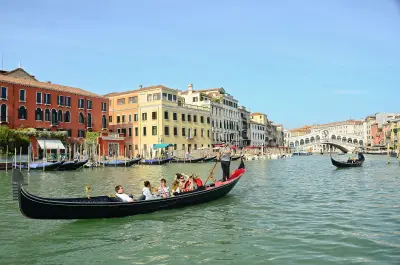
GONDOLAS OF VENICE AND HISTORY OF THE GONDOLIER
A timeless tradition on the canals
The gondolas of Venice are among the city’s most iconic symbols, gracefully navigating its historic canals for centuries. These elegant, handcrafted boats were once the primary mode of transportation. More than just boats, gondolas represent Venetian tradition and skilled craftsmanship passed down through generations. At the heart of this tradition is the gondolier, a skilled boatman who expertly steers the gondola and preserves this historic profession. With their distinctive uniforms and expert navigation, gondoliers are an essential part of Venice’s history and charm.
Today, around 400 licensed gondoliers operate a similar number of gondolas, a significant decrease from the 16th century, when an estimated 10,000 gondolas of all types navigated the city’s canals. However, gondolas had been used for centuries before that, with historical records showing their presence as early as the 11th century.

Gondolas – Venice’s iconic boats
The gondola is a traditional flat-bottomed boat designed for the Venetian lagoon. Its sleek black design has made it an enduring symbol of Venice. Gondolas have been used for transportation since the 11th century and remain the most famous way to navigate the city’s canals. While early gondolas were simple and handmade, modern gondolas are crafted with great attention to detail. A gondolier rows the long, narrow gondola with a single oar, which also serves as a steering mechanism. The boat’s asymmetrical design makes navigating the city’s winding canals easier.
Venice attracts millions of visitors yearly, and many seek the experience of a traditional gondola ride. Today, gondolas are primarily used for scenic tours, typically lasting around 30 minutes. Visitors to Venice can take a scenic gondola ride through its canals before exploring the nearby islands of Murano, Burano, and Torcello, one of the oldest inhabited islands in the Venetian Lagoon, and home to ancient churches. In the past, thousands of gondolas filled Venetian canals, but today, only a few hundred remain.

Styles of Gondola
TRADITIONAL: The most well-known gondola style is typically around 10 meters long, with a single gondolier standing at the back and navigating the boat with their sweep/oar. This traditional gondola can accommodate 2-6 people.
TRAGHETTI: Along the Grand Canal, two-man gondolas called traghetti operate as passenger ferries. Slightly larger than regular gondolas, they can carry up to 12 passengers and serve as a practical means of crossing the canal.
THE VOGALONGA REGATTA IN VENICE: Gondolas are also used in traditional regattas and competitive rowing races, where gondoliers compete using the Voga alla Veneta rowing style. One of the most celebrated events is the Vogalonga Regatta, a symbolic race honoring the Venetian rowing tradition. The event has no official winner, and participants complete a 30 km route through Venice’s canals and the open waters of the lagoon.

Building a gondola
Today’s gondola measures about 11 meters in length, 1.6 meters in width, and weighs 350 kg. Each is handcrafted from 280 individual pieces made from eight types of wood: elm, walnut, lime, oak, mahogany, fir, larch, and cherry. Building a gondola takes about two months, and it can carry between two and six passengers.
Since 1562, the appearance of gondolas has been regulated, with all being required to be painted black by law. The gondola is asymmetrical, with the port side slightly wider to allow the gondolier to stand there for better balance. It also leans slightly to the right for smoother navigation. A special oarlock controls the sweep (oar), allowing the gondolier to row forward, turn, brake, and stop. At the front of each Venetian gondola is a ferro, a decorative iron prow headpiece made of brass, stainless steel, or aluminum, which helps balance the gondolier’s weight at the back. Some gondolas also have a removable cabin cover for privacy and protection.

From public transport to cultural icon
Gondolas were once a primary mode of public transport. They were typically owned by teams of four men, including three gondoliers and a shore-based worker, who managed bookings and administration.
Over time, gondolas evolved into sleek, elegant boats with distinctive curved shapes. During the 17th and 18th centuries, they were Venice’s primary transport mode. Their luxurious decorations and cabin covers provided privacy for Venetian nobility. Their dominance gradually declined in the 19th and 20th centuries with the introduction of motorized transportation. While some gondolas continue to operate as ferries across the Grand Canal, high maintenance costs threaten their future. Gondolas dock at colorful mooring posts in front of grand Venetian palaces, designed for water access, with merchant spaces below and living quarters above.
Experience a traditional gondola ride in Venice!

Private or small group
Shared Gondola Ride Venice Ticket
Go on a gondola ride on the Grand Canal and learn about Venice's secrets from an audio guide! See the Peggy Guggenheim Collection Palace, the Gritti Palace, the Salute Church, the Punta della Dogana, Saint Mark’s Basin, San Giorgio Island, and more. Depending on your preference, you can make it a shared experience with a small group or enjoy a private ride.

Customized itinerary
Private Gondola Ride Venice
Enjoy a private gondola ride in Venice, the perfect way to explore the city’s canals in an exclusive setting. Ride along the Grand Canal, pass landmarks like the Doge’s Palace, Bridge of Sighs, and Santa Maria, and enjoy breathtaking views away from the crowds. This tour is exclusively for your group, providing a unique way to see Venice’s beauty. Experience the city like a true VIP and book a private ride in a traditional gondola today!

Becoming a gondolier
In the past, slaves rowed gondolas, but today, the gondolier profession is highly regulated. Each gondolier must hold one of the limited licenses issued in Venice. Becoming a gondolier requires 400 hours of training over six months and a comprehensive exam covering Venetian history, landmarks, foreign languages, and rowing skills. These skills are essential for navigating Venice’s narrow canals. After training, candidates must pass final exams, including a challenging rowing test. Once they succeed, they can register as substitute gondoliers, work on traghetti (public ferry gondolas), and eventually join the 1,000-year-old Gondoliers’ Guild.
Venice issues only around 400 gondolier licenses, each tied to a specific gondola station, meaning gondoliers always operate in the same location. Gondoliers must buy and maintain their own gondolas. While there are no official restrictions preventing women from becoming gondoliers, only a few female gondoliers are currently licensed and working in Venice.

The life of a gondolier
Life as a gondolier in Venice combines tradition, skill, and dedication. Every day, gondoliers navigate the city canals, sharing Venetian history with visitors while expertly steering their boats. The job required extensive training, a special license, and physical strength to handle the asymmetrical gondolas. Despite the romantic image, the job is physical and demanding. Maneuvering the asymmetrical gondolas through busy waterways requires strength, balance, and endurance. Many gondoliers come from generations of boatmen, preserving centuries-old tradition. While tourism keeps the tradition alive, gondoliers also uphold traditions, participating in regattas and representing Venice’s cultural heritage.

The gondoliers of Venice: Guardians of a floating legacy
Since the 19th century, gondola cooperatives have regulated the profession, but most closed as tourism grew. Regulations became stricter in the 20th century, ensuring that all gondoliers followed licensing rules. Today, the Institution for the Protection and Conservation of Gondolas and Gondoliers in Venice oversees the profession, with all gondoliers belonging to a guild that controls around 400 available licenses.
The Gondoliers Guild also controls their uniform. Gondoliers must wear black or dark blue trousers, black shoes, and a red or blue-striped shirt with the guild’s emblem embroidered on it. Straw hats with ribbons are optional but often worn, maintaining a tradition that reflects Venice’s unique heritage.

Gondolas in art
Gondolas and gondoliers have inspired artists for centuries, symbolizing Venice’s beauty, romance and history. They appear in 15th-century paintings by Venetian masters like Carpaccio and Canaletto, as well as Jacopo de Barbari’s map of Venice. In the 19th century, artists like Grigory Gagarin painted gondola races on the Grand Canal, highlighting their cultural significance. Gondoliers are also featured in literature, opera, theater, and cinema. They are often portrayed as storytellers or figures of the Venetian tradition, presenting Venice’s traditions and way of life. Gondolas and gondoliers remain powerful symbols of Venice, inspiring art in different forms.

Gondolas today and tomorrow
Despite their popularity, gondolas are expensive to build and maintain, and their specialized craftsmanship is declining. The future of gondolas will focus on preserving tradition while adapting to different challenges. Strict regulations will keep the profession authentic, and although gondolas may appear in more cities as attractions, they will always remain a symbol of Venice. Beyond carrying tourists, gondolas play a key role in Venice’s traditions and continue to be used in ceremonial events and competitive regattas.
Most gondolas are individually owned by licensed gondoliers, who must own or lease one to operate. Some are owned by businesses or cooperatives, such as traghetti (public ferry gondolas) that transport passengers across the Grand Canal. A few belong to wealthy individuals or historical institutions, often reserved for ceremonial purposes, preserving this iconic symbol of Venice’s heritage.

Gondolas outside Venice
While gondolas symbolize Venice, they can also be found in other cities worldwide, often as tourist attractions. Many cities worldwide, including landlocked hotels like The Venetian in Las Vegas, have introduced gondola rides as attractions.
A few European cities, such as Stockholm and St. Petersburg, have introduced gondolas for special events or private use. St. Petersburg, often called the Venice of the North due to its extensive network of canals, has started using gondolas for special events and private use. Though these gondolas maintain the traditional design, they serve mainly for entertainment rather than everyday transport.
Explore Venice in style!

Views & bites
Venice Gondola Ride with Dinner
Take your loved one on an enchanting evening with our Venice Gondola Ride with Dinner! You’ll sail through Venice’s picturesque canals in a private gondola, and then, enjoy a delicious 3-course meal at a top-rated restaurant. It’s the perfect romantic outing for anniversaries, birthdays, or just because!

Live music
Venice Gondola Ride with Serenade
Take a romantic cruise through the city of canals with our Venice Gondola Ride with Serenade! You’ll float through Venice in its traditional mode of transportation - gondolas. Musicians will sing Italian songs, bringing the city’s culture to life. Together, the voyage and the song create a magical experience.